
Return to work
 CASE STUDY / 01
Redesigning E-licensing portals
Manitoba eLicensing is how residents buy fishing and hunting licences, apply for big game draws, and get park permits. Vendors, conservation officers, and government staff rely on it too. From June 2025 to May 2026, as Lead Product Designer (Portals), I led UX across five of its portals: Public Payments, Call Center, Finance, Enforcement, and District Office. I extended the existing design standards with the components these portals needed, gave design feedback to the Admin and Public portal designers, and brought Microsoft Copilot into the delivery cycle to handle French translation and speed up an address search feature.
 Manitoba eLicensing portal screens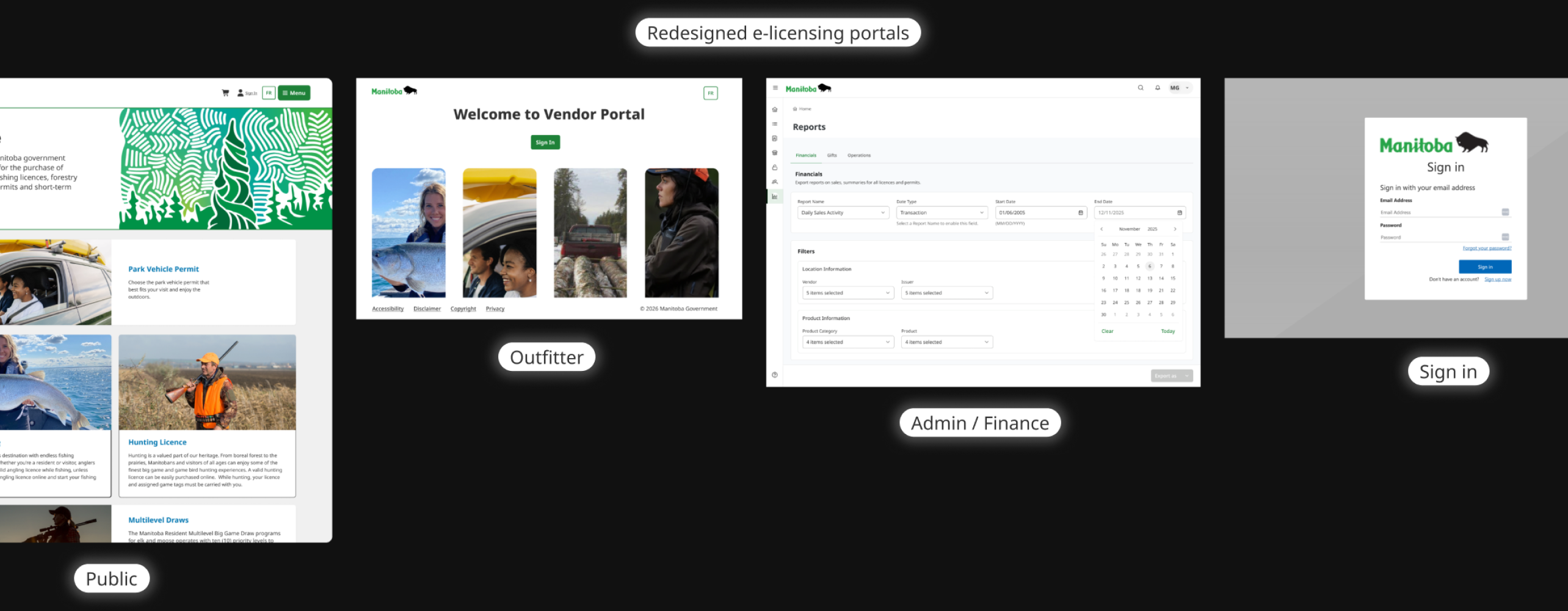
- Problem
- Manitoba eLicensing serves many kinds of users across many portals, and the existing design standards didn't have the components those portals needed. Residents found logging in confusing, mobile purchases clumsy, and eligibility rules hard to understand.
- Why it mattered
- Government portals serve everyone, from a resident buying a one-day fishing licence to a conservation officer checking a licence far from cell service. Inconsistent patterns make services harder to use and slow down the teams building them.
- My responsibility
- Lead Product Designer (Portals) for the Public Payments, Call Center, Finance, Enforcement, and District Office portals, working in a mixed team of about six from June 2025 to May 2026.
- What changed
- New components that extended the existing standards across five portals, Making mobile purchases make clear, Simplifying the process for users portal-wide and Microsoft Copilot workflows that handled French translation and sped up an address search feature.
The problem
A separate team owned the design standards, but they lacked components the portals needed, so similar problems risked being solved in different ways from one portal to the next. The personas showed what was at stake for people: logging in required a customer ID number and password, mobile purchasing wasn't optimized, anglers buying several one-day licences weren't told an annual licence was cheaper, and hunters were unsure which designated lands they could apply for. April to June accounts for 50% of fishing licences sold (source: Government of Manitoba data).
- 01
Start a new feature
Designers started from their own files and habits; no shared standard to begin from. - 02
Design the pattern
Similar problems were solved differently from one portal to the next. - 03
Review and hand off
Where the standards had gaps, reviews and handoff took more back-and-forth. - 04
Next cycle
Manual, repeated steps made each cycle longer than it needed to be.
The core breakdown was not a single screen. It was the gap between the existing standards and what the portals needed.
Many portals serving very different users, all working within each portal's existing delivery cycle. There were real-world constraints too: officers and park staff often work with poor or no connectivity, exemptions such as age or Indigenous rights are complex to verify, and every configuration has to line up with legal and financial rules.
I looked at where the existing standards fell short for the portals and where time was being lost in each delivery cycle. The work drew on a set of proto-personas (June 2025) covering the public (anglers, hunters and trappers, park visitors), enforcement and field staff, retail vendors and outfitters, and admin, finance, and branch staff. Each persona set out goals, pain points, and behaviours to inform design decisions and journey mapping. Figures in the personas come from Government of Manitoba (GoM) data. [Add: who you spoke with, research methods]
The decisions
Three decisions shaped the work: extend the existing standards instead of working around them, give consistent feedback to other portal designers, and bring AI into the delivery cycle.
Extend the existing standards with the components the portals needed
A separate team created the design standards, but they lacked components the portals needed. Rather than letting each portal solve those gaps differently, I designed the missing components so they fit the existing standards. Standards from the Public portal were then reused in the Outfitters portal.
On the Public Payments portal, I created components that let users track exactly what was purchased and shipped and what was given as a gift, cart cards for the cart pages, and the checkout payment steps.
Give design feedback and guidance to other portal designers
I gave design feedback to the designers of the Admin and Public portals, helping keep the work consistent with the standards and with the rest of the eLicensing portals. That included sharing feedback and design solutions on how best to structure hunter questions for public users.
Feedback happened in design critique and sharing sessions every Friday for one hour, with five designers.
Bring AI workflows into the delivery cycle
I introduced Microsoft Copilot workflows into the delivery cycle to take on repeated work.
Copilot handled French translation and helped us quickly incorporate an address search feature.
Leading the work
Leading UX across five Manitoba eLicensing portals meant filling gaps in the standards, keeping portals consistent, and helping other designers do their best work.
Components
Created the components the portals needed on top of the existing standards; Public standards reused in Outfitters
Design standards created by a separate team
Design team
Gave design feedback to the Admin and Public portal designers
Mixed team of about six; weekly one-hour design critique on Fridays with five designers
Delivery
Introduced Microsoft Copilot workflows into the delivery cycle for French translation and a faster address search feature
[Add: product, engineering, and policy partners]
Led UX across the Public Payments, Call Center, Finance, Enforcement, and District Office portals.
Gave design feedback to the Admin and Public portal designers to keep the work consistent across portals.
Looked for repeated work in the delivery cycle and used Microsoft Copilot workflows to handle French translation and quickly add an address search feature.
Supporting the team
Standards and new components are only useful if the team uses them. I worked in a mixed team of about six from June 2025 to May 2026, and gave design feedback to the Admin and Public portal designers. Scrum master, Tech Architect, Tech team, Business analyst, QAs
Led UX across the Public Payments, Call Center, Finance, Enforcement, and District Office portals; created components that extended the existing design standards; gave design feedback to the Admin and Public portal designers; introduced Microsoft Copilot workflows into the delivery cycle.
Partners contributed to the account, product selection, outfitters and Sign-in to name a few.
Huge thanks to fellow portal leads, BA, Entire tech team, scrum master, architects and stakeholders.
The result
The portals now share components that fill gaps in the existing standards, Public standards are reused in Outfitters, and Copilot handles French translation.
5
Public Payments, Call Center, Finance, Enforcement, and District Office.Standards with missing components, and repeated manual work in every cycle
Before-state portal screensNew components extending the standards, consistent feedback across portals, and Copilot handling French translation
After-state portal screensLeading UX across five portals showed me that consistency comes from how a team works, not just from a component library. Filling the gaps in the existing standards and giving consistent feedback let designers spend their time on the problems that matter. [Add: what you would do differently]
[Add: next steps for the components or Copilot workflows, or remove this block]